



By Gary Dickson garydickson@siouxlandobserver.com
There are a lot of places to go for a hike around Siouxland. But one of the most interesting places — at least in my opinion — is the hike across the Meridian Bridge that spans the Missouri River over in Yankton.
And if you look closely at the chainlink fencing beside the pathway, you’ll notice lots of padlocks. At least there were when I hoofed it across the span the summer before last. The bridge is an interesting structure without the padlocks, though. I remember crossing over it on my way to Bogner’s Steakhouse in Crofton, NE with a date during college and family during the 1970s. I recall hearing that the bridge used to be a draw bridge of some sort at one time or another.
The two-tier bridge was built in 1924, and connected the two states of South Dakota and Nebraska, carrying U.S. Highway 81 across the Big Muddy. The top level of the bridge held northbound traffic from Nebraska to South Dakota, while the bottom level was for southbound traffic from South Dakota to Nebraska. That apparently worked fine for 84 years when the bridge closed to all traffic in 2008. It was replaced by the Discovery Bridge a little bit west of the Meridian Bridge.
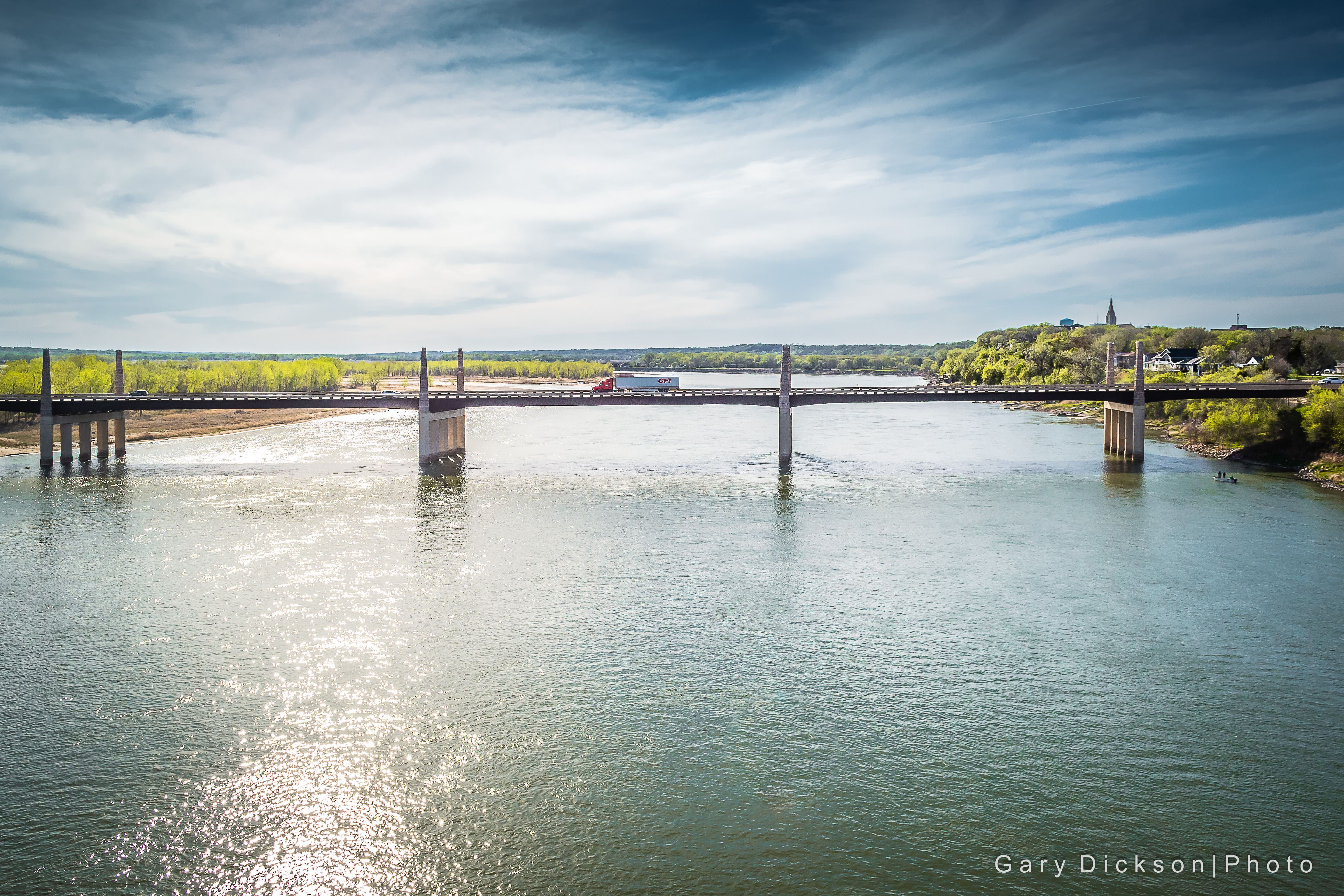
According to Wikipedia, the dedication ceremony was held on October 11, 1924, and the bridge opened as a toll bridge. Besides the dedication ceremony, a parade was also held by the citizens of Yankton heralding the opening of the bridge. The total construction costs came to $1.1 million and the bridge was one of the first to be built over the Missouri River at the time.
It was the last link of the Meridian Highway, which became U.S. Route 81, to be completed. It was designed for use by trains on the lower level of the bridge and vehicular traffic on the upper level; a lift mechanism allowed river traffic to pass below. However, trains never used the lower level.
In 1953, all tolls were lifted and the two levels were converted to one-way traffic: northbound on the top, and southbound on the bottom. In the 1980s, the lift mechanism and counterweights were removed, and the decorative iron railings on the upper level were replaced by Jersey barricades.
With the completion of the Discovery Bridge, the Meridian Bridge has been converted into a pedestrian/bike trail. The bridge reopened in 2010 to non-motorized traffic only. A two-block-long pedestrian plaza has been added. The nearly $5 million dollar project included structural repairs, spot painting, lighting and railings. The 2010 project is expected to extend the lifespan of the bridge by at least another 25 years.
But what about the padlocks?
Glad you asked. According to Wikipedia, they’re known as love locks or love padlocks. But don’t confuse them with Lovelocks, which are locks of hair given as a sign of affection. In fact, a Lovelock was popular among European “men of fashion” from the end of the 16th century until well into the 17th century. The lovelock was a long lock of hair, often plaited (braided) and made to rest over the left shoulder (the heart side) to show devotion to a loved one.
But I digress. I want to explain the purpose of padlocks on bridges, not the fashion styles of King James VI in the 16th and 17th centuries. Anyway, lovers or sweethearts, put their initials or names on these padlocks and maybe even inscribe the date. Then they throw the keys into the river. It all symbolizes unbreakable love, I guess.
Although the locks of love started to appear on Paris bridges in 2008, according to a story in the April 27, 2115 edition of The New York Times, their history dates back at least 100 years to a melancholy Serbian tale of World War I that recounts the love of a young schoolteacher in the spa town of Vrnjacka Banja for a soldier as he was about to go to the front. When Serbia fell, the soldier married a local woman in Greece, where he had been fighting and never returned.
Heartbroken, the schoolteacher died, and young girls in her town who were eager to avoid a similar fate took to placing love padlocks on one of the city’s bridges. The tale was revived and popularized in the latter half of the 20th century by one of Serbia’s most famous female poets, Desanka Maksimovic, in a poem titled “Prayer for Love.”
Ceri Houlbrook, a professor of folklore at the University of Hertfordshire in the United Kingdom who has researched and written a book on the history of love locks has said that the first evidence she found of the custom was in Pécs, Hungary, in the 1980s, but it was associated at the time with a punk movement, not romance. Around the same time in Italy, members of the military placed padlocks on a bridge as a form of celebration.
“Whenever you get something a bit odd in a public space, a tourist space, tourists start to just imitate doing it,” Houlbrook said. “So they started doing it and documenting it on social media, and it just spread globally from there.”
In some parts of the world, like Paris, the custom has become so mainstream, that there are people on a bridge selling padlocks for love-struck tourists strolling by.
It’s a bit different down in Arizona’s Grand Canyon. Lovers there have been showing their feelings towards one another by etching their names or initials on padlocks and locking them on fencing along the south rim of Grand Canyon National Park. They then throw their keys into the canyon.
This act of romance apparently annoys the park’s Rangers, who view the padlocks and various accouterments such as chains and artificial flowers as litter. So, every two years they remove the padlocks with bolt cutters. One Ranger remarked on a Facebook page that the padlockers’ love was strong, but not as strong as their bolt cutters.
The Park’s Rangers don’t like the custom of the keys being tossed into the Grand Canyon, either. They’re concerned that birds like the California Condor that inhabit the area might be attracted to the shiny keys lying on the canyon soil and ingest them, possibly getting stuck in a bird’s digestive tract.
I’m not sure what happens to the keys after they’ve ended up in the Missouri River underneath the Meridian Bridge. I suppose they flow downstream a bit, like everything else. Maybe a paddlefish eats them or they end up along the shoreline somewhere. That would be a great question to ask one of the specialists from the South Dakota Game Fish and Parks.
I haven’t been over to walk on the Meridian Bridge for a couple of years. I should probably do that to see how many padlocks have accumulated on the bridge. Now that I think about it, I’m starting to worry a bit. What if this love padlock thing has become really, really popular? Like during the Sturgis Motorcycle Rally time in early August, hundreds . . . no, thousands of bikers go through Yankton to put padlocks on the Meridian Bridge signifying their undying love with their biker partners. Wow!
Then what happens if there gets to be too many padlocks on the Meridian Bridge? What if the bridge starts to sag from too much love padlock weight — and falls into the Big Muddy?
And what if that happens during the centennial of the bridge next year on Oct. 12, 2024 when masses of people are gathered on the bridge celebrating the event. And . . . Oh, never mind. My wife says I worry too much about things that will never happen.
She could be right.
 The Siouxland Observer