


By Gary Dickson, Editor garydickson@siouxlandobserver.com

The Dakota Valley School Board received good information last Monday evening Nov. 13 when Superintendent Dr. Tonia Warzecha gave a report on the district’s college-bound juniors and seniors’ recent performance on the ACTs.
Those readers growing up in South Dakota and other states may recall taking the ACT exam in high school. It is a national college admission exam that consists of subject area tests in English, mathematics, reading, science, STEM and (optional) ELA, also known as English Language Arts and Writing. ACT results are accepted by all four-year colleges and universities in the United States.
The ACT consists of 215 multiple-choice questions with an optional writing (essay). It takes approximately three hours and 50 minutes to complete. Students are given one to two short breaks during the exam.
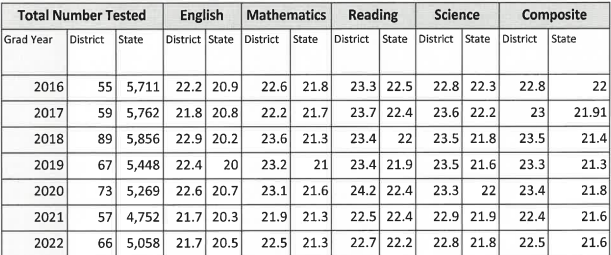
The table above shows how college-bound Dakota Valley juniors and seniors did on the ACT exam in 2016 through 2022 and compares their performance to the average of those in the State of South Dakota. The table also provides the number of students testing each year. As might be expected, the year 2021 showed a drop in the numbers. This would reflect the fact that numbers were likely impacted by COVID. The year 2023 also showed a drop in numbers, which is not explained, as the data was retrieved after the school board meeting. Every subject area shows DV students scoring higher than the state average each year. Table provided by Dr. Tania Warzecha. The last line of data was retrieved from the SD Department of Education website on 11/23/23.
So, does doing well on the ACT mean a student is ready for college? Of course, that depends on a lot of things, like emotional maturity. But as far as academic readiness is concerned, that’s where measurements like the ACT come in.
According to the ACT website, the exam has more than 60 years of research behind it. The required academic skills can be assessed most directly by reproducing, as faithfully as possible, the complexity of the work students do in the classroom. Therefore, ACT’s tests of educational achievement are designed to determine how skillfully students solve problems, grasp implied meanings, draw inferences, evaluate ideas and make judgments in subject-matter areas important to success in college.
ACT scores can be used in combination with other relevant measures to estimate
students’ likelihood of success in college during the first year and beyond and to help
inform college admission, course placement and remediation decisions.
ACT has established college readiness benchmark scores for designated college courses. A benchmark score is the minimum score needed on an ACT subject-area test to indicate a 50 percent chance of obtaining a B or higher or a 75 percent chance of obtaining a C or higher in the corresponding credit-bearing college courses.
The following table of benchmark scores was provided by the South Dakota Department of Education. It is from ACT’s profile report for the graduating class of 2023 in South Dakota.

Again, Dr. Warzecha pointed out to the board that in all four subject areas, DV students averaged higher than the ACT benchmark score. That is up from the previous year where district students exceeded the benchmark scores in three out of four areas, falling short in science.
Summative Assessments look good
The superintendent also took time to bring to the attention of the school board members the performance of district students in grades three through eight and 11 in the areas of English Language Arts (ELA) and mathematics at each grade level. She showed the board the South Dakota Summative Assessment of 2022-23 results.
According to the state Department of Education, the South Dakota Math and English Language Arts Assessments are administered to students in grades 3-8 and 11. They measure student knowledge mastery/understanding of state content standards in math and ELA. The assessment system includes both summative and interim assessments. The summative assessment is administered every spring to all students in tested grades, while the interim assessments are optional for districts to use. The assessments use computer adaptive testing technologies to provide meaningful feedback and actionable data that teachers can use to help students succeed.

“Students in grades five through eight participated in the South Dakota Science Assessment,” Dr. Warzecha said. “The assessment is designed to assess the science content standards adopted in May 2015. Individual student reports identified each student’s level on a scale of 1-4 and provided comparison scores of the district and the school.”

So, how does Dakota Valley do as a whole when compared to the rest of the state?
“We perform at a higher level in all three content levels,” said Dr. Warzecha proudly as she showed the table below to the school board members.

Food service passes inspection with flying colors
Business manager Jill Sponder reported with some pride that the elementary school kitchen had a routine inspection by the SD Department of Education on Oct. 6.
The kitchen received a score of 100, which means everything was in compliance, including employee health, hygiene and practices; food sources, protection and all operations.
Sponder and the board also discussed surplus school property and what to do with it and an upcoming financial audit of the district.
North Shore Drive Bypass
Jon Brown, President of Stockwell Engineers gave a presentation to the school board about the North Shore Drive Bypass. He explained the various options the South Dakota Department of Transportation (SDDOT), the US Department of Highways and the City of North Sioux City were looking at for the large construction project.
The project involves constructing a new road to bypass Northshore Drive. The goals of this project are to alleviate traffic and safety concerns on Northshore Drive and provide necessary utilities to the surrounding area to meet the needs of North Sioux City. The project improvements are expected to include new concrete surfacing, curb and gutter, storm sewer, water main, sanitary sewer, and lighting.
Due to efforts by the City of North Sioux City and SD Senator Mike Rounds, a $17M grant was awarded to construct a new bypass road between Interstate 29 and Westshore Drive. This grant was earmarked for the project as Congressionally Directed Spending, as part of the 2022 Federal Omnibus Bill. The grant is administered through SDDOT with North Sioux City acting as the local sponsor. SDDOT awarded an engineering contract to Stockwell Engineers for the survey, design, and bidding of the project. Stockwell is acting as the project manager under the direction and administration of SDDOT.
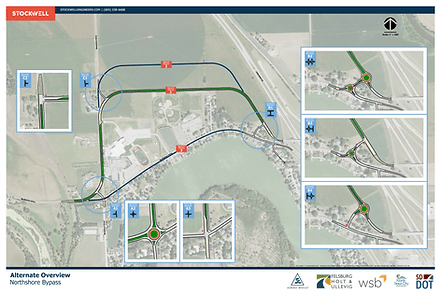
The total projected costs of the project are in the neighborhood of $24 million, but that includes contingency funds in case of construction cost overruns and the amount North Sioux City will kick in for the project. There has been some misconception by landowners in the county that the $24 million is coming directly from the city, but that isn’t true, said Brown. There is $17 million in the Congressionally Directed grant money that’s part of the project.
One of the issues discussed at the meeting was what kind of intersections would be utilized with the bypass. Brown stated that hasn’t been finalized yet, but probably the most efficient and safe one would be a roundabout west of the school.
Brown introduced Chad Huwe who will be Stockwell’s project manager for the North Shore Drive Bypass.
More business
In other business, the school board:
- Heard a report from activities director Bill Clements where he reviewed the results of the competitive cheer and dance, cross country and volleyball teams. He also reported the esports team started practice on Nov. 2 and had their first preseason competition on Nov. 14 and the first official competition on Dec. 4. The team has 25 players on its roster that will compete in four different game titles during this pilot year.
- Clements also told the board there are more than 24 youth basketball teams scheduled in the school’s gyms. All teams have at least one practice a week with several of the teams with older kids practicing twice weekly. The gyms are being utilized every school night, except Wednesdays, until 9:00 p.m. plus various weekend times.
- Heard a report from elementary principal Kristi Maloney that Sara Eckhoff was honored during the All-State Choir and Orchestra event in Rapid City with an award for 40 years in music education. She also reported that there was 99 percent attendance rate by parents at the October parent-teacher conferences. It was the highest number of attendees the elementary school had had at the conferences since 2019.
- Nichole Herzog, Upper Elementary/ Middle School principal and dean of students Ben Blaeser talked about the success of Red Ribbon Week, 7th-grade guest speakers, the DV Cares program, Panthers of the month and community service. They also reported on a new student ambassador program in the upper elementary/middle school to provide tours to incoming students and their families, provide information about what the school offers, and be a guide for new students. They provided tours, helped with lockers, introduced them to teachers and helped them learn about DV Cares expectations.
- High school principal Erik Sommervold and assistant principal Jeff Hamm told the board that on Oct. 3 the senior class completed the National Career Readiness Test. The chart below shows the level of certification DV students attained. The chart shows the scores from this year (2023%) and the previous year (2022%).

- Sommervold and Hamm also reported back to the board that a survey had been conducted with local businesses within the Dakota Valley community regarding the possibility of youth internships. Nineteen of the businesses contacted had responded by the meeting. Of those 19 businesses, 13 have said they are interested in partnering with the school district with internships. Six of the businesses were unsure at this time. They received a contact for each business that completed the survey. Sommervold and Hamm said they would be getting in touch with the contacts to answer questions and share more information regarding the internship program. They said board member Andrew Nilges and Barbara Sloniker from the Siouxland Chamber of Commerce were helpful in sharing the survey with the local business community.
- IT director Michael Oberg informed the board that 52 percent of the district staff had completed cybersecurity training as of Nov. 8. He expects the entire staff to complete training by Dec. 15.
- Oberg said he, Dr. Warzecha and board member Nilges held a video conference with Renee Bachner, Trifon Goouvas and Ryan Graham to discuss concerns about Verizon’s coverage in the area and inside the Dakota Valley school buildings. He said Stuart Sveeggen from Verizon was onsite on Nov. 3 to survey the signals inside and outside the buildings. Sveeggen took his findings and will visit with the Verizon network team to formulate a plan to come up with actions that can be taken to improve the cellular service in the area.
- Facilities director Michael Brzostowski made a report summarizing recent equipment repairs and replacements, including winterizing the concession stand and restrooms at the athletic complex. He also reported that the compressor for the HVAC unit for the high school second-floor IT closet has failed. A new one has been ordered. Brzostowski said he is in the process of getting a bid package together for replacing the fire alarm system at the elementary school. He also informed the board that old student personal file cabinets at the middle and high schools have been replaced with new fireproof cabinets. Brzotowski said he will dispose of the old broken cabinets. Lastly, the facilities director said, recent roof leaks have been repaired in the middle school choir room middle school east hall by the first skylight, hallway by room 323, east Nylen Science entrance and the elementary school art room kiln area.
- Linda Steele, special services director gave the board an update on the DV RISE program. She said upper elementary/middle school students have been provided with opportunities to do “reverse inclusion” where students from general education participate in activities with RISE students with the special education program. Steele also summarized how Lewis and Clark Behavioral Health Services presented information to the DV administrative team and school counseling team. She said DV has had a long history of accessing individual therapy from Lewis and Clark. She talked about some of the services that the agency offered to the community.
 The Siouxland Observer